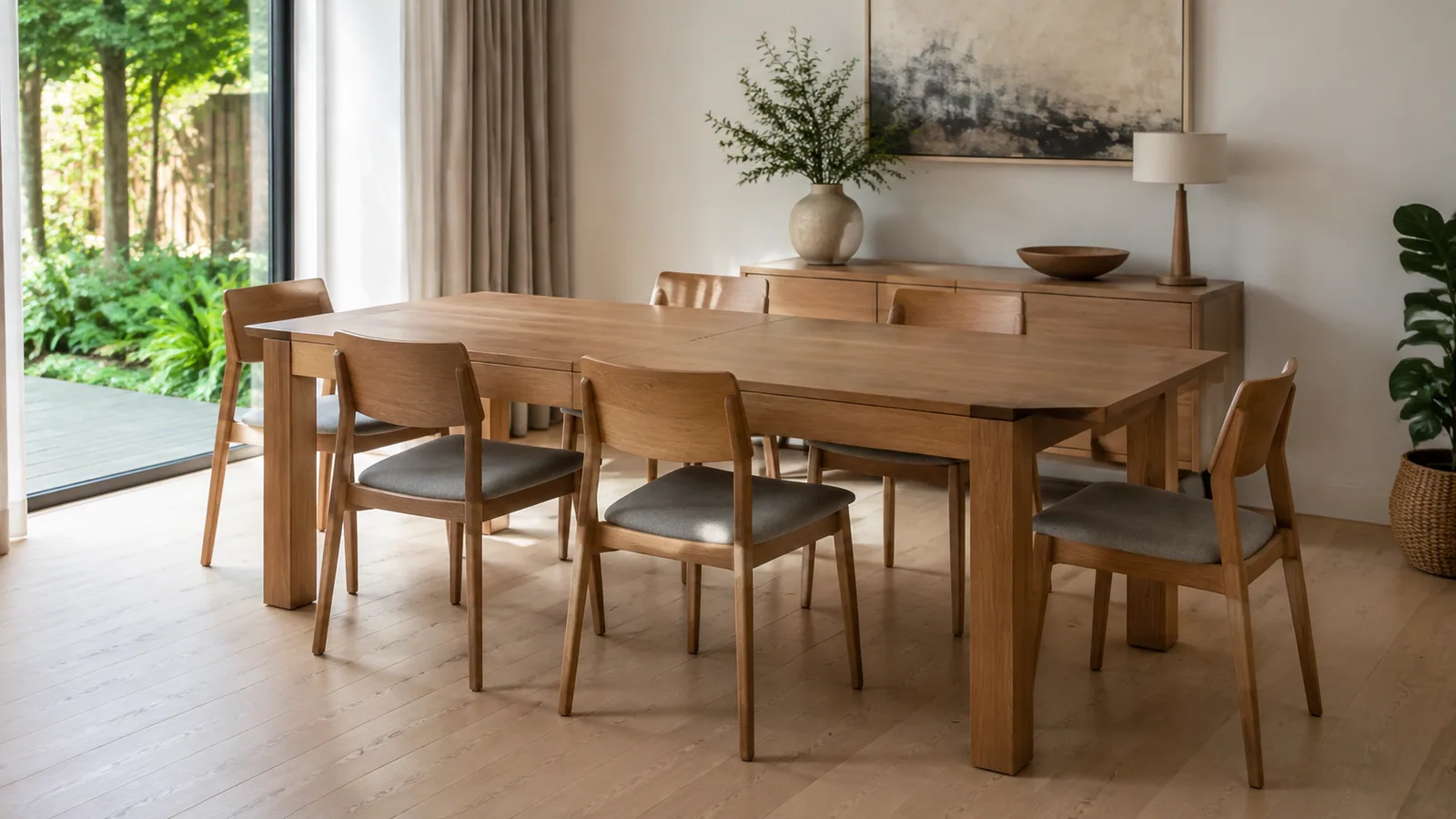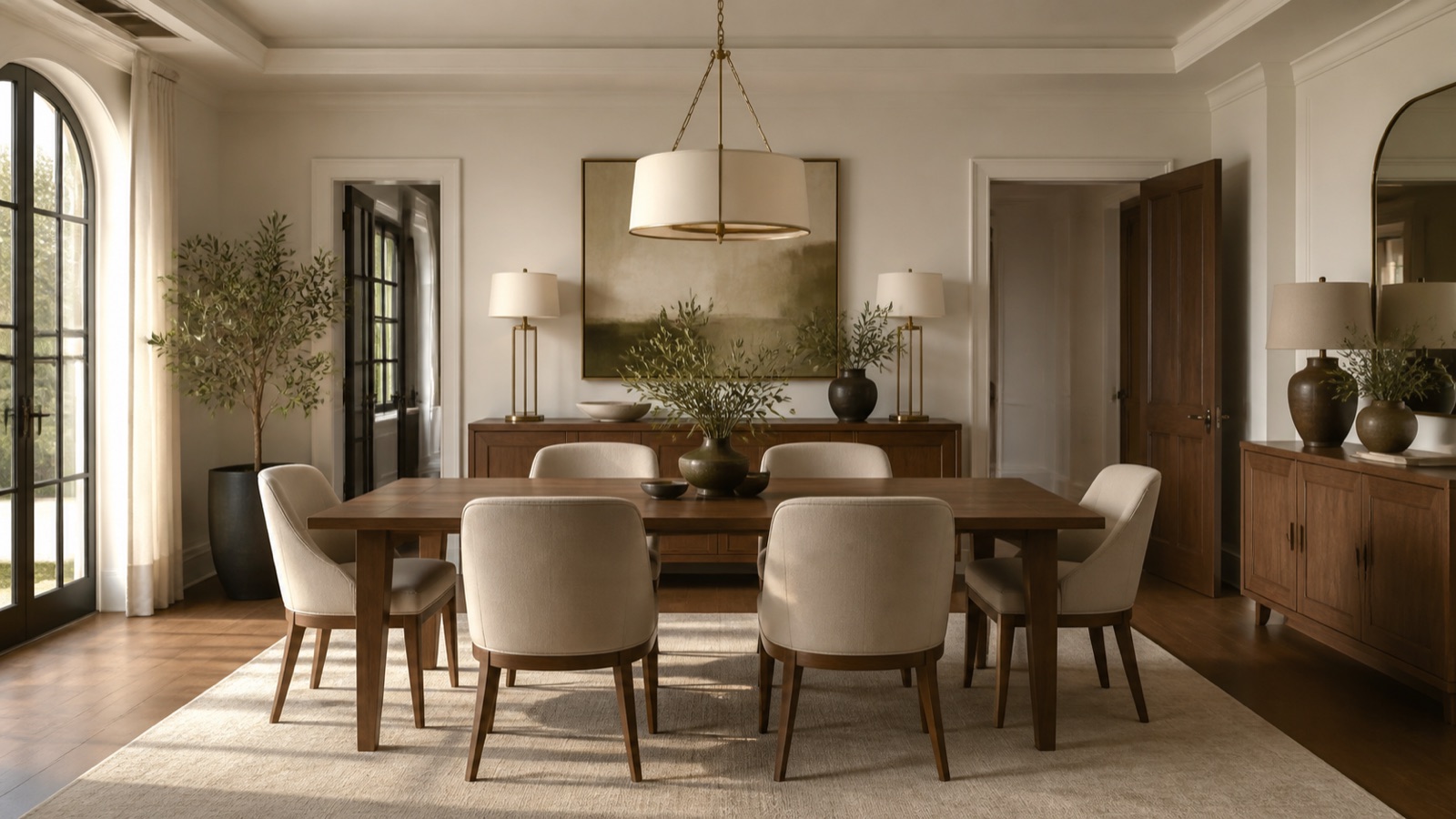
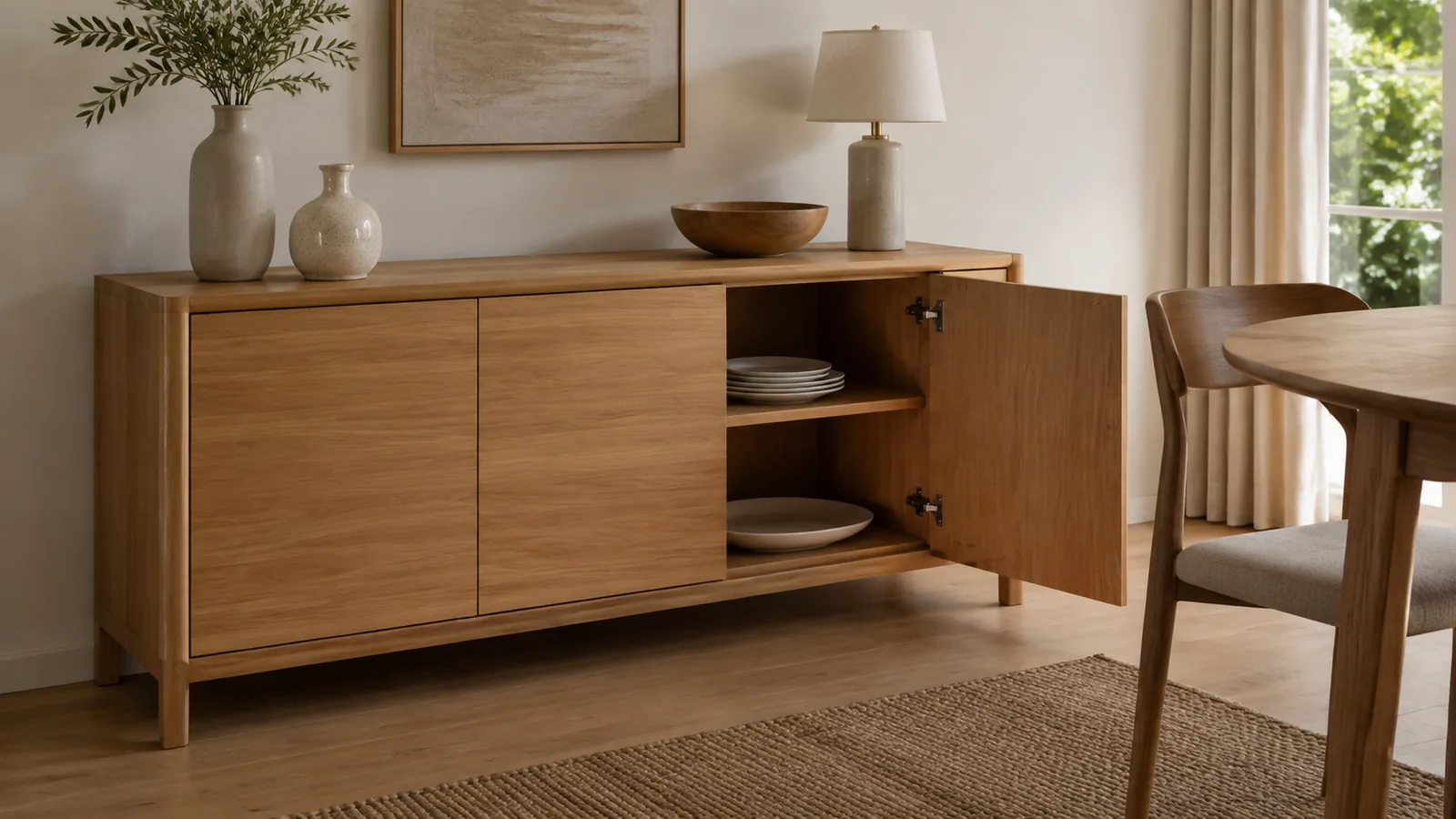
A sideboard needs to hold your serving pieces and open comfortably beside the dining table. Measure the storage inside and the space outside before choosing.
A buffet can fit a wall perfectly and still fail its main job. The serving platter may be too deep for the shelf, the cupboard opening too narrow, or a drawer may stop against a dining chair. Exterior dimensions tell you where the cabinet sits. They do not tell you what it stores or how easily you can retrieve it.
Start with the belongings you want to put away, then test the cabinet with its doors open and the room in use. This gives you a shortlist based on useful storage, rather than the number of doors in a photograph.
Decide what the cabinet will do
Give the sideboard a clear job. A dining-room buffet might hold crockery, table linen and serving dishes. A living-room cabinet might hold games, paperwork and occasional-use items. Combining those jobs can work, provided the internal layout gives each group an accessible place.
List what currently has no suitable home. Leave out items you intend to remove; buying storage for an unresolved pile can carry the same problem into a larger cabinet. Keep frequently used belongings distinct from pieces brought out only a few times a year.
If you mainly need a narrow display surface or a place for keys, our console table guide addresses that different role. For closed storage, look inside the candidate buffet before deciding that its outside proportions are right.
Measure the awkward items first
Choose the largest objects in each group: the broad platter, tall jug, stacked dinner plates, cutlery organiser or board-game box. Record width, depth and height in millimetres. Include handles, lids and the way you actually store the object.
A jug lying on its side may technically fit, but that is not a useful solution if you want to remove it upright without rearranging the shelf. Measure plate stacks in the quantity you normally lift together. Include any protective storage box or divider you plan to use.
Write down where your hands need to go. An object that occupies the entire opening may be difficult to grasp even when its dimensions fit. Test loading and retrieval with the actual item, or a similarly sized template, where practical.
Ask for internal dimensions and clear openings
For every shortlisted model, distinguish three measurements: the cabinet's exterior, the shelf space inside, and the opening through which an object must pass. Hinges, centre divisions, drawer runners and door edges can affect that opening.
Ask for usable shelf depth with doors closed, clear width between divisions and the height available at the intended shelf position. For drawers, request the inside width, depth and height rather than the front-panel size. A deep exterior can include a substantial back, doors or framing.
Check whether shelves are fixed or adjustable. If adjustable, ask about the available positions and the permitted load for each shelf. Do not assume moving a shelf creates usable capacity everywhere: a higher jug compartment leaves less space above or below it.
Compare useful capacity with a worked example
Imagine a serving platter measuring 420 mm wide × 330 mm deep × 40 mm high. The following cabinet measurements are hypothetical and do not describe Queen Style products.
| Check | Cabinet A | Cabinet B |
|---|---|---|
| Exterior width | 1600 mm | 1400 mm |
| Clear shelf width in one compartment | 390 mm | 450 mm |
| Usable shelf depth | 350 mm | 360 mm |
| Clear opening width | 370 mm | 430 mm |
| Initial platter result, stored flat and straight | Too narrow in this orientation | Dimensions pass an initial check; retrieval still needs testing |
The narrower cabinet has a wider usable compartment in this example. Cabinet B leaves just 10 mm across the opening beyond the platter width: 430 − 420 = 10 mm. That is a reason to test the handling, not a claim that 10 mm is sufficient clearance. Rotating an item might help in some cabinets, but the opening, interior and safe handling all need checking together.
Test doors and drawers beside the dining setting
Mark the cabinet's full exterior depth, including handles, on the floor. Then mark how far each door or drawer projects when opened as instructed. A closed-front photograph hides this working space.
Place the dining chair in its normal position, then pull it out as someone would when standing. Check whether another person can reach the cabinet without moving the seated diner. Repeat with the nearest room door open and any main route in use.
Pay attention to end doors beside a wall or corner. The door may need to open beyond a small angle for a drawer, shelf or large object to be accessible. Ask for the model's opening requirements; do not assume all hinged doors behave alike.
Plan the top separately from the storage
Decide whether the top is mainly for display or occasional serving. Check the product's surface-care instructions, load information and any protection needed for drinks or serving dishes. The appearance of a timber, stone-look or glossy finish does not establish its construction or resistance to heat.
Keep frequently handled objects within comfortable reach and avoid filling the whole surface. If a lamp will sit there, include its base and cable route in the plan. Do not assume a buffet can support a television because its top is wide; use furniture intended and rated for that purpose.
Include anchoring in the placement decision
The ACCC's toppling furniture guide includes buffets and sideboards and recommends securing furniture to the wall or floor. Follow the exact product warnings and installation instructions, with fixings suited to the wall or floor construction. Ask a tradesperson if you are unsure.
Choose the position with anchoring in mind before loading the cabinet. Follow shelf and drawer load limits, keep heavier stored items low and keep objects that might attract climbing away from the top. A low-looking cabinet still needs its safety instructions followed.
Your buffet storage worksheet
Use one row per important item group. Write “not supplied” where a dimension is missing, then request it before deciding.
| Item group | Item or stack W × D × H, mm | Intended compartment | Clear opening and internal fit checked? |
|---|---|---|---|
| Serving dishes | __________ | __________ | __________ |
| Dinnerware | __________ | __________ | __________ |
| Linen or cutlery organiser | __________ | __________ | __________ |
| Other essentials | __________ | __________ | __________ |
| Cabinet and room check | Your result |
|---|---|
| Exact model and finish | __________ |
| Exterior W × D × H, including handles | __________ mm |
| Door swing or drawer projection | __________ mm |
| Access with dining chairs occupied | __________ |
| Shelf positions and load information | __________ |
| Anchoring instructions and wall suitability | __________ |
| Packed dimensions and delivery route | __________ |
Common questions
Is there a standard sideboard size?
There is no single size that determines a useful fit. Compare the exact exterior, internal compartments and opening movement with your room and belongings.
Does a wider buffet always hold more?
No. Divisions and drawers can produce smaller compartments inside a wider cabinet. Compare the storage layout item by item, as in the platter example.
What should I check before ordering?
Resolve missing internal measurements, test opening space and confirm the current product instructions. Use our delivery measuring guide for the route into the room, then compare the buffets and storage collection with your completed worksheet.