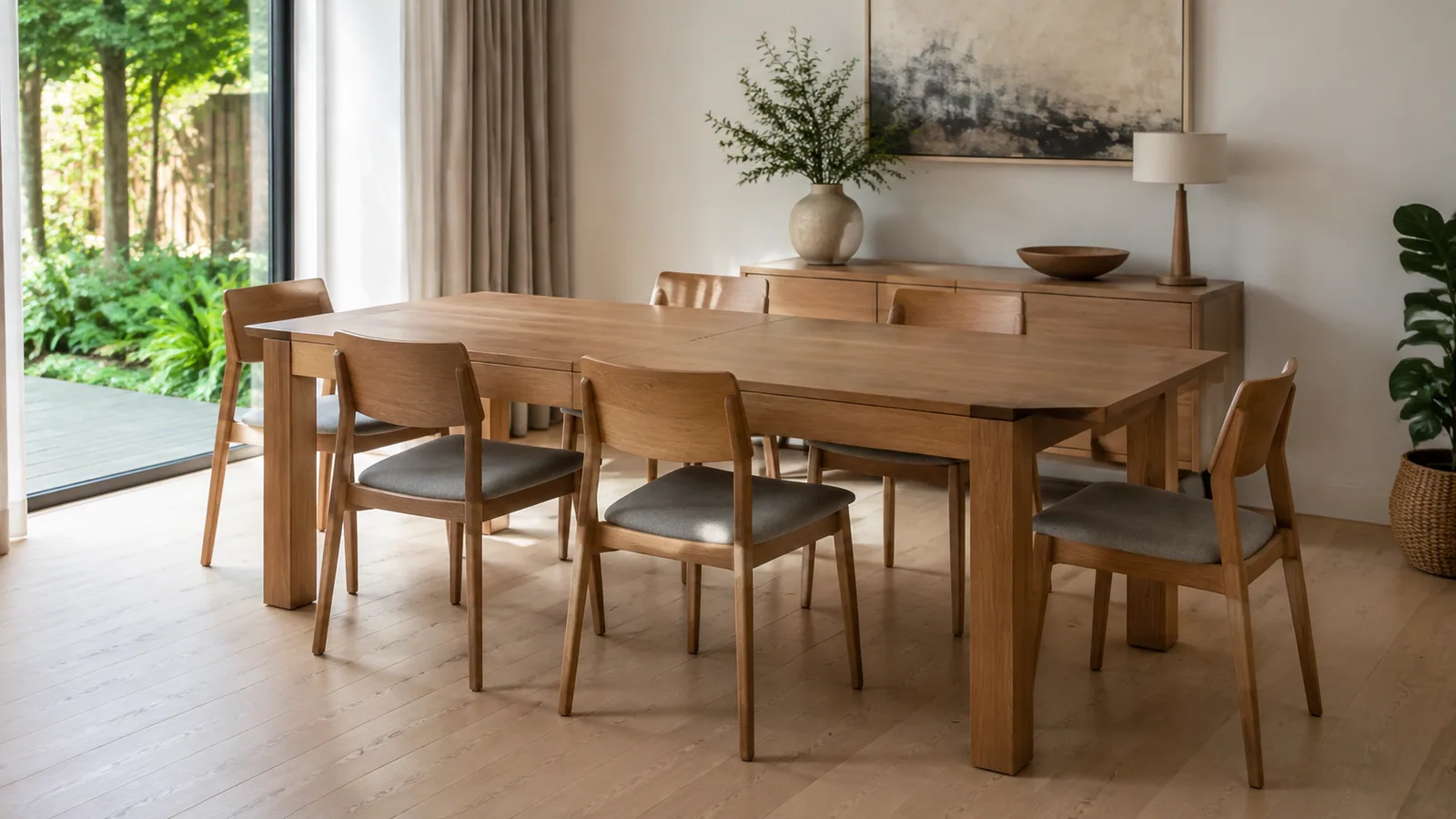
An extendable table needs to work on ordinary evenings and when guests arrive. Compare both footprints, the conversion process and where extra parts live.
An extendable dining table offers more than one tabletop size, but the useful choice depends on more than its maximum length. The everyday layout needs to work, the extended layout needs usable seating, and changing between them needs to be practical for your household.
Treat the purchase as three connected checks: closed, open and in transition. A table that passes only one or two of those checks may not provide the flexibility you expected.
Write down the two occasions you are planning for
Record the ordinary number of diners and the occasional gathering you want to accommodate. Include the chairs you already own or intend to buy. The question is whether these actual people and chairs fit the two arrangements you need, rather than whether a broad seat-count label sounds generous.
Describe how often the table is likely to change size. Extending it a few times a year creates a different routine from changing it for work and dinner every day. Consider who will normally operate it and whether the required help will be available.
Our dining table size and shape guide covers general room layout and seating proportions. This guide adds the measurements and operating checks that become necessary when the table itself changes.
Record every approved tabletop configuration
Ask for the closed length and width, each permitted intermediate size, and the fully extended dimensions. Confirm which leaves or extension components are included with the exact variant. Do not assume a table with two leaves is intended to be used with just one unless the instructions allow it.
Record how the top changes position. Does it grow at one end, at both ends or around a central opening? Do the legs move, or does the top extend beyond a fixed base? That distinction affects where the table, chairs and diners sit in the room.
Keep the configuration names consistent on your plan: closed, intermediate if permitted, and fully open. A single “length” entry on a shopping note can easily refer to the wrong one when you compare products later.
Mark closed and open outlines together
Use two distinguishable outlines on a room plan, or removable markers suitable for the floor. Begin from the table's intended reference position. Add nearby walls, cabinets and doors, then place the actual chairs in both arrangements.
Test the route to the kitchen and other rooms with people seated. Check the buffet with its doors or drawers open. If the table has to move for entertaining, include the new position and follow the manufacturer's handling instructions; do not assume it can be dragged across the floor.
Consider a hypothetical table that changes from 1600 mm to 2200 mm long. The added length is 600 mm. If it grows equally at both ends while its centre stays fixed, each end moves 300 mm outward. If all the added length appears at one end, that end moves 600 mm. These are alternative geometry examples, not descriptions of any Queen Style model.
That difference matters beside a doorway or cabinet. The same total open length can use the room differently, so confirm the actual extension movement before relying on a centred outline.
Recheck legs, aprons and chair arms when extended
A longer tabletop does not automatically create a useful chair position. Inspect where the legs, rails and pedestal sit in each configuration. A new diner may otherwise face a support exactly where their knees or feet need to go.
Compare the distance between legs with the widths of the chairs intended for that side. For chairs with arms, check the lowest underside or apron where the arms need to pass, including any extension hardware beneath the top. Repeat this in the open position; the closed table does not answer every question.
Sit at the added places as well as the usual ones during a demonstration where possible. Include place settings and serving needs in the comparison. For more detail on chair measurements, use the dining chair buying guide.
Watch the complete extension and closing process
Ask for a demonstration of the exact mechanism, following its instructions. Start with the table closed, extend it to the intended size, secure it as directed and return it to the closed position. Note which parts must be moved, lifted, aligned or locked.
Confirm the required number of people, clear working space and any handling restrictions. Keep hands and objects clear of moving joints as instructed. If the process feels awkward during a supported demonstration, resolve that before assuming it will be easier at home.
Manufacturer claims are model-specific. For example, IKEA describes its VIHALS extendable table as extendable by one person, with an extra leaf stored beneath the top. Those features describe that product; they should not be transferred to another table without checking its own information.
Give leaves and extra chairs a storage plan
Ask where every removable component goes when it is not in use. If leaf storage is built in, have it demonstrated and check how it affects the underside space. If storage is separate, measure the leaf and identify a suitable location that follows the supplier's handling and storage instructions.
Do not improvise an orientation, support or protective covering without checking what is appropriate for the material. Keep the instructions accessible so the occasional-use parts can be handled correctly when the next gathering arrives.
Plan where the extra chairs live too. A compact closed table offers less everyday benefit if several unused chairs block the surrounding room. Record whether those chairs have another useful place and whether bringing them back is manageable.
Compare the whole setup with one worksheet
Use millimetres throughout. Missing information is a question for the seller, not a dimension to infer from a photograph.
| Check | Candidate A | Candidate B |
|---|---|---|
| Exact model and included extension parts | __________ | __________ |
| Closed length × width | __________ | __________ |
| Approved intermediate size, if any | __________ | __________ |
| Fully extended length × width | __________ | __________ |
| Which ends, legs or supports move? | __________ | __________ |
| Clear chair bays, closed and open | __________ | __________ |
| Lowest underside and chair-arm fit | __________ | __________ |
| Main route and cabinet access in both layouts | __________ | __________ |
| People and space required to operate | __________ | __________ |
| Leaf storage demonstrated or measured | __________ | __________ |
| Extra-chair storage location | __________ | __________ |
| Packed components and delivery access checked | __________ | __________ |
Add one final line: “The configuration we will use most is __________, and the compromise we accept is __________.” This makes the everyday decision explicit instead of allowing the largest advertised size to dominate it.
Common questions
Is an extendable table always better for a small room?
Only if the closed arrangement, open arrangement and conversion process all work there. Check the two outlines with chairs in use and a real place for the extra parts.
Can I leave the table extended?
Ask about the exact model's intended use, support, care and locking instructions. Do not assume that advice for another extension mechanism applies.
Can I keep my existing dining chairs?
Possibly. Measure their width and arm height, then test the actual positions around both table configurations. A compatible tabletop height alone does not establish clear leg and arm space.
What should I confirm on the order?
The model, finish, included leaves, approved dimensions and current delivery arrangements. Use the delivery measurement guide for access checks, then compare current dining-room furniture with both layouts beside you.